When Facebook Went Down
On Monday 4 October 2021, disaster struck. A ‘faulty configuration change’ took Facebook, Messenger, WhatsApp and Instagram offline for six whole hours impacting 3.5 billion users worldwide. From 16:00 GMT on Monday afternoon until 22:00 at night, people attempted to connect without success. In fact, a whopping 10.6 million problems were reported around the world – the largest number ever recorded – with many more Facebook services fans silently grumbling into their coffee mugs.
It was clear Facebook was having quite a tough time. But what exactly caused the social media giant to fall off the internet’s map for hours? And what can we learn from this unprecedented event with regards to marketing and business management?
The Facebook Outage – What Went Wrong?
It’s all a bit techy and complicated. But put simply, Facebook’s engineers somehow issued a command that unintentionally took down all the connections in its network, “effectively disconnecting Facebook data centres globally.” This sent Facebook headquarters into something of a meltdown, with problem solvers even unable to access the building.
Santosh Janardhan, the company’s infrastructure vice-president, added that Facebook’s program audit tool had a bug and failed to stop the command that caused the outage. The outage also caused employees to lose access to internal tools, including those used by Facebook employees to correct such issues. These tools included Facebook internal email.
According to Facebook, there was no evidence that user data was compromised.
What was the Damage?
While the outage was just a bit of an inconvenience for many, with people triple-checking their device’s internet connection, Facebook CEO Mark Zuckerberg was having a much worse day. At one point he lost an incredible $6 billion (£4.4 billion) from his personal fortune as Facebook shares plummeted according to business website Fortune’s tracking software. But he wasn’t the only one to suffer.
A rough calculation provided by fact-checking website Snopes suggested that the social media giant haemorrhaged $79 million in ad revenue during six hours of downtime – though this is caveated by some assumptions on the consistency of ad spend.
The Impact on Businesses
The financial damage was undoubtedly in the millions. But it was the realisation that Facebook’s reliability cannot be counted on that would have shaken many businesses to the core, especially those with a strong social media presence and no business website. Indeed, many businesses rely on Facebook/Instagram’s infrastructure to operate, with 80% of the social media giant’s income coming from SMEs. Think of all the businesses operating Facebook shops, running social media ads or making the most of social shopping tools. Downtime for them potentially reduces income and visibility severely.
What Can Marketers Learn From this Event?
- Don’t Rely Solely on Social Media for Marketing Purposes
First things first, the main lesson is not to rely solely on social media for marketing purposes. While having a Facebook or Instagram presence and using tools such as WhatsApp and Messenger to communicate with clients is great, it shouldn’t be the only way to promote your products or boost brand awareness. Ultimately, you’re not in charge of the backend of these platforms and can’t control any future outages or data breaches. Therefore it’s a good idea to create your very own branded website which can still run if another social media blackout occurs in the future.
- Future Proof Your Digital Marketing Campaigns
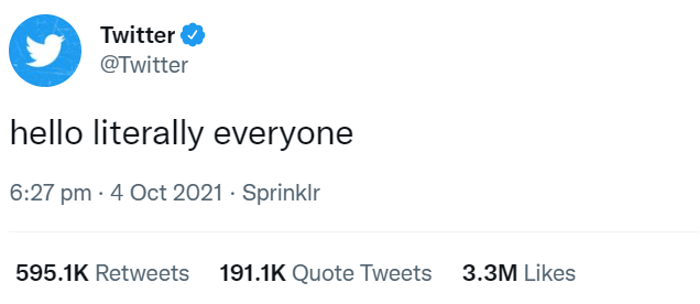
Putting all your eggs in one basket is never good. You might have paid for Facebook ads during a product launch. But what if the site crashes? Try to future proof your digital marketing campaigns by investing in Google Ads, or by working hard on your SEO strategy to ensure you rank well for particular keywords. You might also want to boost your presence on Twitter too, as it’s based on a separate platform and wasn’t impacted by the Facebook error.
- Don’t Be At the Mercy of Price Hikes
Social media may, at some point, charge business users for creating a business profile. If you’ve not taken other steps to promote your business, you’ll be backed into a corner and forced to confront this extra financial burden.
The Facebook outage has given us all something to think about. And it all comes down to balance and not being reliant on social media only.