SEO News for June 2021
Like any other business, Google constantly makes changes to ensure they provide the best user experience possible. Being a search engine giant, Google’s main goal is to deliver the most relevant results in the SERPs which is why they’re constantly evaluating content and fine-tuning what they present. A Google update isn’t a new thing. Small updates happen all the time and go unnoticed by the majority of site owners. There are also far bigger updates that overhaul the whole ecosystem and can impact your rankings dramatically.
Staying on top of the latest SEO news is a must as it’ll help you to prepare for and embrace any potential search ranking changes. June was a particularly busy month with Google rolling out a whole bunch of updates. So what exactly happened and how might the updates impact you going forward? Let’s take a closer look.
June 2021 Core Update Rolled Out
Google carried out a two-part core update this summer. The June 2021 Core Update started to roll out around 6.30pm ET on Wednesday, June 2 and was confirmed to be complete on June 12. Like all core updates, this was a global update and not specific to any particular region, language or category of websites. Core updates tend to happen every six-months or so, with the previous core update taking place on December 3, 2020.
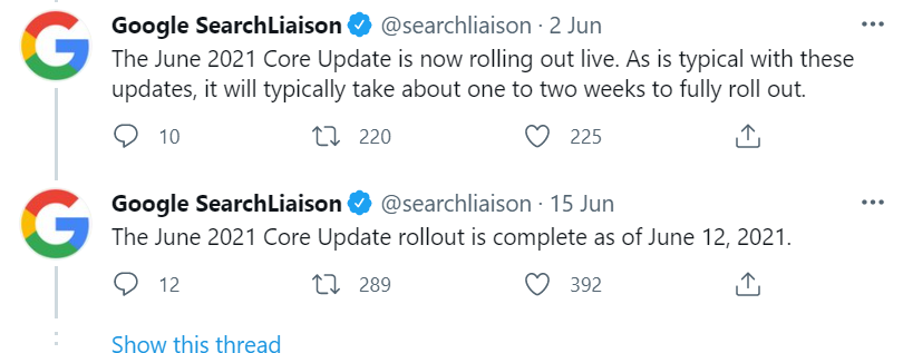
Image credit: https://twitter.com/searchliaison
The goal behind core updates is to ensure that Google gets better and better at assessing and providing relevant content to searchers’ queries. After all, they’ve a reputation to maintain and want to enhance the user experience at every opportunity. And it makes complete sense for updates to happen on a regular basis when content production and website changes occur daily. So what was the impact of this rollout?
Well, a lot of ranking fluctuations were reported towards the end of the rollout period. Algorithm changes would have resulted in pages that were previously under-rewarded being boosted while others would have seen a drop in traffic. To spice things up, even more, Google also made it clear that part-two of the rollout could also reverse the rankings that resulted from the June update stating: “Of course, any core update can produce drops or gains for some content. Because of the two-part nature of this release, it’s possible a very small slice of content might see changes in June that reverse in July.”
The reason for the two-part release is that some of Google’s planned improvements for the June 2021 update simply were not fully ready to be released in June. So, Google decided to move ahead with the parts that were ready, and the rest would be pushed out in the July 2021 Core Update. Notifications were given via social channels such as Twitter.
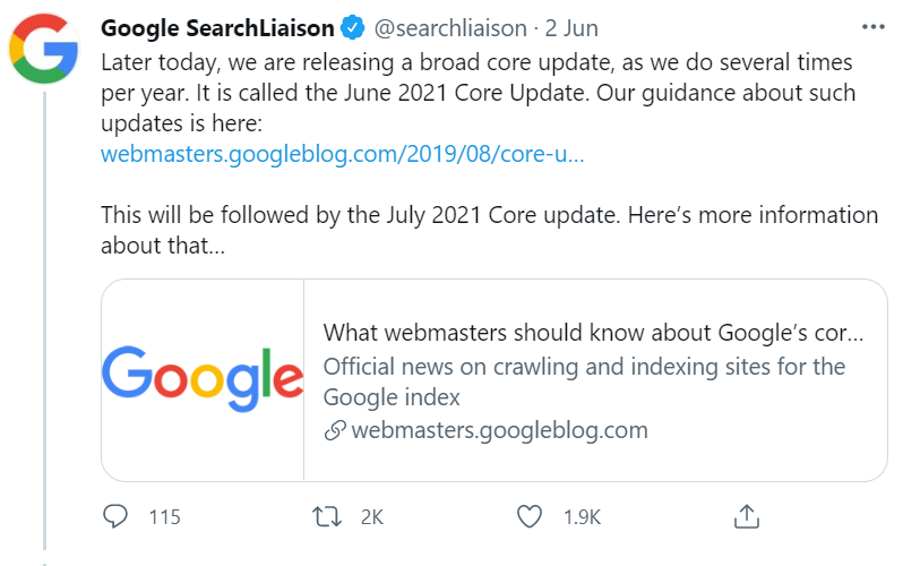
Image credit: https://twitter.com/searchliaison
Responding to the Update
As a digital business with an interest in search rankings, keeping an eye on your analytics and data is a must to see how you’re impacted by the updates. One of the main things to do consistently to help you navigate future updates is to always fill your site with relevant, up-to-date and authoritative content which answers common search queries. This is because Google is looking for the best content for each search and the updates are aligned with this.
Google Page Experience Update Begins to Roll Out
In other news, Google announced that its long-awaited Page Experience update would start to roll out slowly in June and be completed by the end of August 2021.
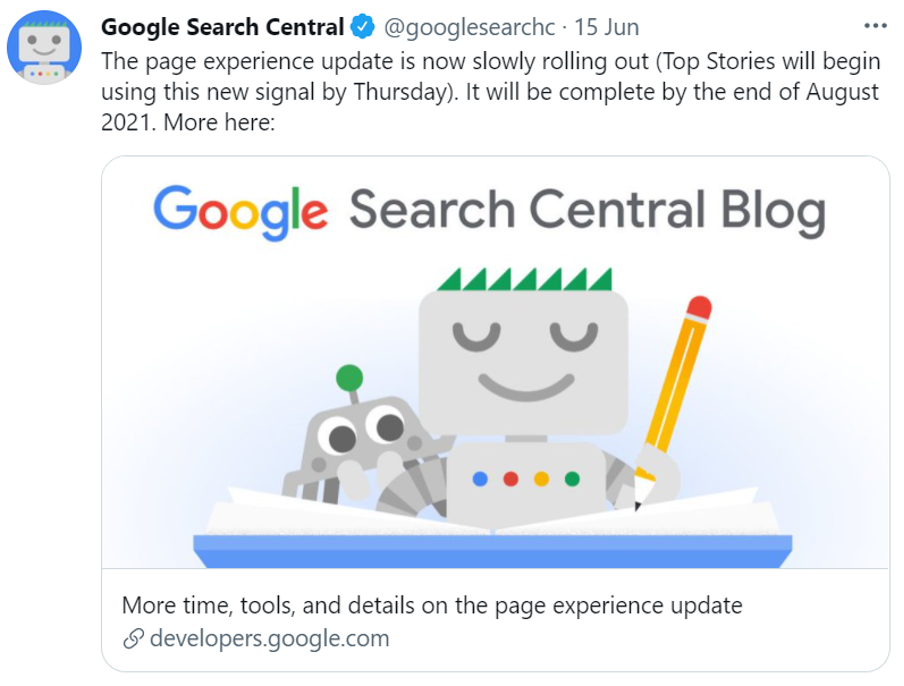
Image Credit: https://twitter.com/googlesearchc
A Google announcement stated:
“We’ll begin using page experience as part of our ranking systems beginning in mid-June 2021. However, page experience won’t play its full role as part of those systems until the end of August. You can think of it as if you’re adding a flavouring to a food you’re preparing. Rather than add the flavour all at once into the mix, we’ll be slowly adding it all over this time period.”
Due to the slow rollout, sites should not experience any drastic fluctuations as a result of this update. There also hasn’t been any new features or surprises thrown into the mix, so site owners can rely on the information that’s already been shared across the SEO community. With this in mind, let’s take a look at what the page experience update consists of.
What is the Page Experience Update?
The Page Experience update is all about creating the optimal browsing experience for users. Essentially Google takes into account several signals before giving each website an overall ‘page experience’ score. Site owners are able to view their score in the new page experience report in Search Console.
Here is a rundown of each of the signals and what is required to get a page experience score that’ll improve your chance of appearing highly in Google SERPs.
Core Web Vitals
Core Web Vitals were introduced by Google back in May 2020 and will now play a role in receiving a good page experience score. These metrics measure and evaluate the speed, responsiveness and visual stability of websites and offer opportunities for a ranking boost when managed well.
Core Web Vitals include Largest Contentful Paint. This measures how long it takes a page to load from the point of view of an actual user. Such page speed insights provide information about the overall page experience. There’s also First Input Delay. This measures the time it takes for a user to actually interact with your page. Interactions can include choosing an option from a menu, clicking on a link in the site’s navigation, entering your email into a field and more. Finally, there’s Cumulative Layout Shift. This is how stable a page is as it loads and refers to visual stability.
Mobile Usability
A page should have no mobile usability errors in order to achieve a good page experience score in the new update. So if your website hasn’t yet adopted a mobile-first approach with regard to optimisation, it’s really important that you focus on this over the next month or so.
Security Issues
In order to achieve a good user experience status, your site must be free from security issues. Google needs to know that if it recommends your site in the SERPS, that it isn’t putting users at risk of viruses, malware and such like.
HTTPS Usage
A page must be served over HTTPS to be eligible for a good page experience status.
Ad Experience
When it comes to user experience, there’s a lot to think about including how you use ads on your site. Essentially, to ensure people enjoy visiting your site, advertising techniques must not be distracting, interrupting or presented in a way that will disrupt the flow of content. When designing your website and the ads you want to include, always think about things from a visitor’s perspective. Would you like to spend time on your own site? Or are there things you can do to make the experience better?
As part of the Page Experience update, Google has also stated that AMP is no longer a requirement for pages to be included in the Top Stories carousel. In addition, Google is expanding the usage of non-AMP content to Google News and removing the AMP badge icon from search results.
To Note: The Page Experience update currently only applies to mobile search results. It will eventually roll out to desktop, but this is likely to happen much further down the road and probably not before August if predictions are correct.
PageSpeed Scores Updated in Lighthouse 8.0
The Core Web Vital integration into the Page Experience update has highlighted how important speed is for rankings. But Core Web Vitals aren’t a fixed thing. They change and evolve over time and are being constantly improved. This makes the whole process quite tricky from a technical perspective.
The kit that manages PageSpeed scores has been updated, with Version 8.0 of Lighthouse changing some of the measures themselves including the relevance and importance of PageSpeed measures. This means some scores will get better and some will get worse.
From an SEO perspective, this means that page speed and performance is something that you need to work on constantly in order to achieve a decent page experience score.
New Tools Announced for Businesses
Google has recently announced more tools for businesses. Here’s a rundown of the newest ways you can use Search and Maps to share information about your business on Google.
#1 Update Services
If you offer local services such as construction, auto repair, hair styling, nails, massage and more, you can now use the ‘Edit profile’ menu on Search to easily update the services you offer and the local areas you service where applicable. You can also showcase your specialities. For instance, if you’re a nail salon specialising in gel nails, then this can feature in your service information.
#2 Accept Food Orders
Did you know that Order with Google lets food businesses accept orders for takeout and delivery directly through their Business Profile on Google Search and Maps? This makes it a whole lot easier for businesses to reach new customers and turns regular Google searches into profitable orders. This is a particularly important and significant update for many companies during these unprecedented times, particularly considering food ordering on Google has increased 230% since last year, largely due to the pandemic.
#3 Google Posts
Google posts have been around for a while, but there are updates that you might not be aware of. Essentially, ‘posts’ are mini-updates, like a blog post or a tweet on your Google My Business profile. These turn up in the search content, particularly for branded searches, and allow you to provide up-to-date information about events, offers, services, opening times and more. One of the most recent additions to Google Posts is that you can now include a Covid-19 update telling people how you’re operating during the pandemic. This is topical, engaging and can have a huge impact – particularly if you’re open or taking orders online which people may not have been previously aware of.
To Note: Companies are increasingly starting to think of their Google My Business Profile in the same way as they do their homepage. This is, after all, the first place where many people will encounter your business and maybe make decisions based on the information you provide as well as the images they see, reviews and opening times.
#4 Shop Pay
It was recently announced that e-commerce platform Shopify’s one-click checkout service known as Shop Pay will become available to any US merchant that sells on Facebook or Google – even if they don’t use Shopify’s software to power their online stores. This makes Shop Pay the first Shopify product offered to non-Shopify merchants.
Google confirmed at its I/O developer conference that it was partnering with Shopify on an online shopping expansion that would give Shopify more than 1.7 million merchants the ability to reach customers through Google Search and other shopping journeys that began through other Google properties like Search, Maps, Images, Lens and YouTube.
If you’re looking for help with your digital strategy including marketing and SEO, don’t hesitate to contact Whitefish Marketing. As an SEO agency based in Kent, we specialise in improving brand awareness through organic search rankings as well as PPC campaigns. We also offer a wide range of other services including web design, video production – and more.