Google Ad Copywriting Strategies
You know your target market and have a solid keyword list that you’ve thoroughly researched and are confident with. You might have even refined your bidding strategy, knowing the exact amount of money you’re willing to spend for a single click on a given keyword in Google Ads. But if you’re hesitant about writing the ad itself, worry not. Here are five copywriting strategies for creating ads that convert.
What is Ad Copy in Google Ads?
Let’s just recap the basics. Google Ads is a paid online advertising platform offered by Google that helps businesses to connect with billions of people who are looking for answers on Search, watching YouTube videos, exploring Google Maps, discovering Google Play apps, browsing content and more. This service allows you to easily advertise and promote your products and services when users search-relevant keywords. And when done right, it has the potential to turbo-charge your leads and sales. Google Ads appear at the top of the SERPs and look almost identical to organic results save for the bolded ‘Ad’ label at the top of the post.
Ad copy in Google Ads is the bit people see and read. It’s super important to note, however, that you don’t have much time to get your key messages across. Google only allows 90 characters for your headline and 180 characters for your description. So if you’re prone to waffle, it’s time to cut that out and get straight to the point.
There are also 8 different types of ad campaigns with Google Ads. These include:
- Search – Text ads on Google search results
- Display – Image ads on websites or on Gmail
- Video – Video ads on YouTube
- Shopping – Product listings on Google
- App – Your app promotion on many channels
- Smart – Simplified automated ads on Google and across the web
- Local – Drive customers to a physical location
- Discovery – Runs ads across Google’s feeds when they’re open
For the purpose of this article, we’re focussing on the copywriting elements of Google Ads.
How Do I Make Google Ad Copy More Effective?
#1 Focus on Consumer Pain Points
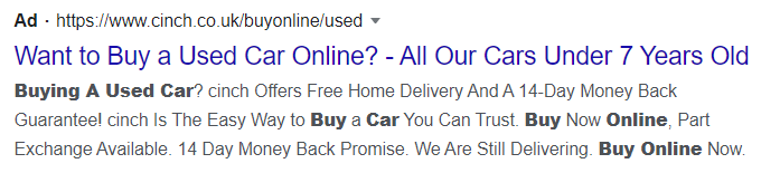
Hopefully, you’ve already carried out thorough keyword research and have a good idea of what people type into Google to find your products and services. User intent must be at the front of your mind when creating ad content, and should aim to address consumer pain points quickly. This will make your ad relevant and ensure consumers get the answers they’re looking for via your content. When crafting your ad, you could try including a specific search query in the title, such as ‘Buy a Used Car Online.’ Use your keyword research to inform what needs to go here. Stand out by adding a USP into the title too. The description then needs to concisely explain what you offer and how you can benefit the end user. Here’s an example of an ad that gets the point across quickly and concisely.
#2 Include a Strong Call to Action
You’re bidding for clicks, so don’t waste your money. Be sure to tell people what they need to do and make your call to action strong. Google ads copywriting cannot be weak or fluffy. It must be direct and to the point, with every ad having a unique purpose.
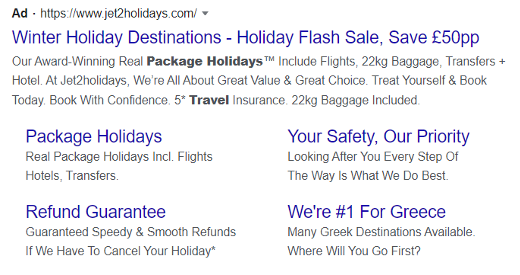
Don’t try to cram too many messages into any single Google Ad. Instead, think carefully about what you want that particular ad to achieve, be it to increase sign-ups, promote a new product or drive a promotion. Check out the below example that focuses on a winter holiday flash sale with the call to action being, ‘Treat Yourself & Book Today with Confidence.’
#3 Establish Your Authority
One of the best things you can do in any Google Ad is focus on specific details that’ll establish your industry authority and help you to stand out from the crowd. Don’t be afraid to mention things you’re proud of. Look at the example above from Jet2holidays and how they mention they’re #1 for Greece. Competition is rife, particularly with more businesses now online due to the pandemic, so it’s really important to shout out about your expertise.
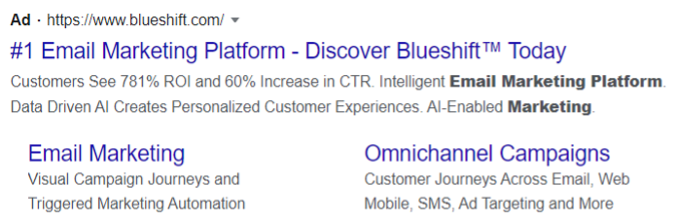
Here’s another example that uses statistics to impress the end-user.
#4 Create Ads Around Promotions
If you’re looking for other ways to stand out, then creating ads around promotions is a good idea. While your competitors might be offering similar services, look to see how you can outdo them with your offers and incentives. When crafting promotional ad content, be sure to think carefully about the words you use. ‘Free,’ ‘Discount,’ ‘Money Off,’’ are all words and phrases that will catch the attention of your audience. You might also want to pop in specific figures such as 50% off or 0% Finance.
#5 Use Power Words
Similarly, there are a number of other powerful words that’ll make your ad copy even more enticing. These are designed to create a sense of urgency or evoke certain emotions among your audience, ultimately encouraging them to act. Words like ‘Opportunity,’ ‘Exclusive,’ add a sense of interest while ‘Limited Time Only’ or ‘While the Offer Lasts’ create a sense of FOMO. People hate the thought that they’ll miss out on something good and are more likely to act. Simple techniques such as putting ‘Easy’ in front of a service you offer can also make your brand seem more approachable and accessible.
If you’re looking for Google Ads Management and an AdWords Agency that can streamline your PPC strategy, then don’t hesitate to contact Whitefish Marketing today.