Understanding Meta Tags
SEO learning level: SEO for Beginners
Understandably we know that some of our viewer-ship is comprised of small business owners looking to enhance visibility for their new websites. As such, a useful SEO guide or a step-by-step solution to SEO for new websites will come in hand right about now. So to that effect we wanted to help by offering a quick lesson on Meta-Tags, which WILL be essential as part of your SEO learning.
What exactly are Meta Tags?
Meta tags are snippets of data that reside behind the screen but help Google and other search engines to understand what your webpage is about. There are 3 types of meta data fields you will see in both the source code of your webpage, and also in the back end of your CMS system – where you create the pages for your website.
These are:
– Title Tag
– Meta Description
– Keywords
Why are Meta Tags so important for SEO?
Meta tags help the search engines to categorise your webpage for indexation. Lets go through each element in more detail and you will understand its importance.
TITLE TAG:
Your title tag, is usually coded quite high on the page. This means that when the search engine crawlers reach your webpage to index, the title tag is one of the first things it reads. Imagine you own a library, and you needed to catalogue all of your books. For you, as the librarian, the most important thing would be to know the title of each book. Just as Google (and other search engines) are the librarians of the internet, they too need to know the title of your page, so as to best allocate it when people make a search relevant to your product/service.

Your title tag has a limited number of characters available (it changes regularly depending on Google updates) but it should be kept short and to the point – i.e. absolutely relevant to what your page is discussing. Currently search engines read about 65-70 characters of your title tag. So don’t bother wasting time creating longer ones.
How should title tags be structured?
“What should I enter as my Title Tag?” is a question I get asked a lot when talking with SEO beginners. Understandably, if it’s an important feature (which I’m saying it definitely is) and only has limited character space, then people want to learn what’s considered best practice.
Sadly it’s never as simple as saying “enter it exactly like this”. As mentioned above, you need to keep it short and sweet and absolutely relevant to what the page is about. Otherwise it’s pointless and not really a title. However there are other factors, such as brand, keyword, and location which should also get a look in.
Brand – where possible you want to add your brand on the meta title tag. Most importantly if you are administering on webpages which are specifically about your company. e.g. home page, contact us page, about us page etc.
Keyword – this should come naturally, as your content will also contain principle keywords which you are targeting for (if you are doing your SEO correctly!)
Location terms – following from Google’s “Venice” updates, where location (or local SEO) now plays a strong factor in the search results, it can be argued that location terms are also vital for inclusion. Likewise, you can’t always add on location terms to every page, so concentrate on those where location is a topic of discussion. e.g. contact us page, how to find us, directions, our store locations etc.
One last thing about meta title tags. Try to be natural and form sentences. Long gone are the days when you could just stuff it with keywords such as “[brand], [keyword 1], [keyword 2], [location]”. A more natural feel such as “Welcome to [brand], offering [services] throughout [location]” should be adopted.
META DESCRIPTION:
Just as a title tag can be compared to a book title, your meta description could be likened to the synopsis on a book’s dust cover, allowing the viewer/reader a little more insight into the novel before they read it. The same acts for search engine crawlers. Underneath the title tag resides the meta description tag, giving a brief synopsis of the page.
The meta description also doubles up as your Elevator Pitch*
(*elevator pitch is a predominantly American term and comes from the idea that if your were riding the elevator with someone… Should they ask you want you do for a living, you can concisely answer it in one to two sentences in the duration it takes to rise a floor.)
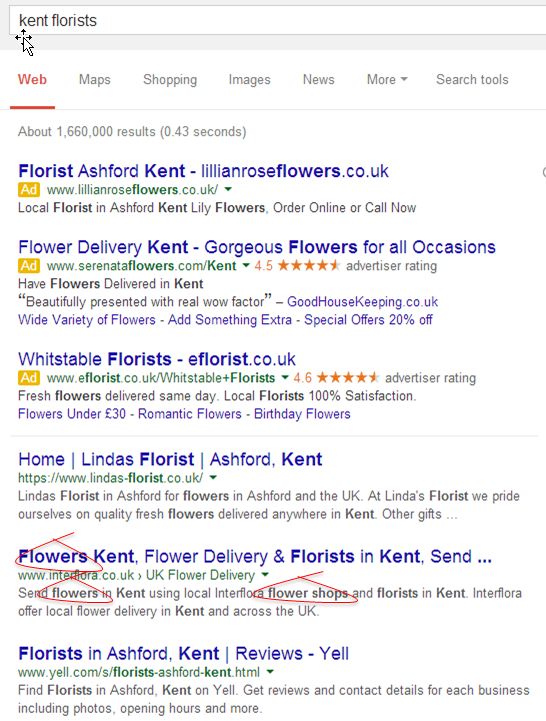
Along with your title tag which gets shown, the meta description is the blurb of text that’s also displayed on the search results when viewers have performed a search. Getting yourself ranked high in the search engine results is one feat, but that is not the total effort required. Also ensuring you stand out from your competitors is key. The search engine results page will appear noisy, with competition all vying for real estate on the page. Your meta description is your HOOK to entice people to click on your website, as opposed to another.
From an SEO point of view, relevant keywords which match those being asked (and synonyms of the keywords) will also be highlighted, increasing your chances of being seen. See screenshot above for the example using “Kent Florists”
META KEYWORDS:
These were (past tense) simply a list of about 5-10 keywords, or tags, which would help search engines categorise your webpage. They were used like identifying tags. However, it has long since been noted that the meta keywords are no longer being taken into account by the larger search engines, such as Google, and potentially could be marked negatively against you. In the past, this functionality was being misused and wasn’t a real indicator of what the page was. Webmasters could simply put what they wanted, regardless of it’s relevance, and therefore a decision was made to discount them entirely.
Another reason why meta keywords should NOT be adopted, is that any of your competitors can view your your meta data in the source code at any time. Subsequently they will know what SEO terms you were trying to target and potentially adjust their campaigns accordingly. In the world of business, you obviously don’t want to be showing your cards to the guy over the road.
In short… Meta Keywords are no longer in use for SEO purposes, and although that functionality still exists in almost every CMS software, that field should be left blank.
Summary of this Meta Tags lesson
Firstly…Don’t forget about meta tags!
Many many companies forget about meta data when they create a page. They concentrate so much on the content for the human reader (which is absolutely correct) but too often they forget that it’s the meta data which search engines are hungry for. Both are equally important.
Working with software developers in the past, for bespoke websites, I have often lobbied strongly that meta data fields should be made mandatory so you can’t set a page live without them. I feel it is THAT IMPORTANT.
Conversely I find many companies still adopting the old principle of including (or rather spamming) the keyword field will a cluster of terms. As mentioned earlier, this is very “old hat” and something I try hard to drum out of new clients if they are still doing this. It can potentially work against them.
Remember that each meta tag has a function
A Title Tag has a different bearing than a meta description, but are both essential for Branding, Commercial Keyword Targeting, and Location setting.
So there you have it, hopefully that helps present a slightly clearer explanation of what meta data is and its relevance for successful SEO campaigns.
I won’t go into this now (this article is more for SEO 101, rather than advanced SEO) but your meta data is not purely used for SEO. It also has bearings on the efficiency for your PPC campaigns as well as social bookmarking.
More Articles on SEO “SEO 101: Introduction to SEO”
Contact Whitefish Marketing for any other queries
For more details on the benefits of SEO and how it can help your business, contact Whitefish Marketing today, at our Kent SEO office on 01303 720 288 where one of our friendly team members will happily help.