So what exactly is SEO (Search Engine Optimisation)?

A synopsis of SEO

SEO (or search engine optimisation) is absolutely fundamental for your digital marketing success. It forms the building blocks for the rest of your online marketing efforts.

Search engines (such as Google) process over 8.5 billion searches per day, and getting your business to stand out for queries that are relevant to your industry is tough.  Search Engine Optimisation is the practice of giving your web pages the best possible visibility in the search engine results pages (SERPs) for related queries (Such as “Accountants in Croydon” or “Tax Advisors in Birmingham” etc.).  The higher your pages rank in Google, the more traffic will reach your website. And more traffic can be turned into more clients.

SEO activities come in many forms, and takes a long time to build up – there is no quick fix or fast solution.  It should be seen as an investment over the long term, rather than a flash-in-the-pan exercise.

Why does your accounting firm need SEO?

In a highly competitive industry, it’s essential for businesses to give themselves the best possible chance of being found online. By improving your company’s visibility for relevant searches, your website will gain more traffic, which means more potential clients for your accounting practice.

SEO gives your accountancy firm a solid foundation on which to build the rest of your digital marketing strategy. It focuses on getting your pages to rank as highly as possible in the search engine results, driving traffic to your website. But it doesn’t stop there. Once on your website, potential clients have to be confident that they can trust you, and SEO ensures that you present an authoritative image while encouraging users to convert.

Benefits of SEO

Drawbacks of SEO

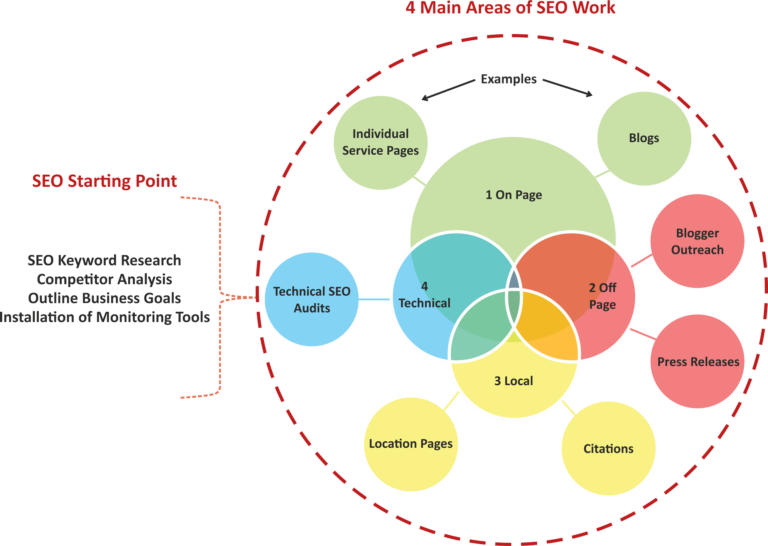
4 Main Areas of SEO Work

Our approach to SEO for accountants

At Whitefish Marketing, we approach SEO for accountants from four key angles: On-page SEO, Off-page SEO, Localised SEO and Technical SEO.

On-page SEO is about what YOU have to say about your own website. This element of SEO is completely within your control and requires no other 3rd party involvement, therefore Google considers content very seriously. On-page SEO is about content marketing and thoroughly optimising that content for best use.

Off-page SEO is about what OTHERS have to say about your website – in essence it’s a digital “word of mouth” referral. The more votes of confidence from other 3rd parties the better. However, quality can be more important than quantity. Vast volumes of backlinks from low level sites can increase your spam score and negatively impact your site’s reputation. SEO linkbuilding is a contentious area and must be done professionally with due diligence and care.

Localised SEO is about how visible your company website is, based on localised search queries in Google. We look at dominating localised terms before spreading further afield to more generic terms. Localised terms will also help build your authority over time as well. Even for national coverage, the activities conducted at a local level still add significant value to your overall SEO campaign.

Technical SEO is about how your easily your website can be crawled and indexed by Google (and other search engines). If the website is coded inefficiently, it makes it harder for the search engine “robots” to rank your company website in their search results. Full technical audits can include as many as 180 sectional checks across various elements of your website.

By combining all these aspects of SEO, we give your business the best possible chance of ranking highly for search queries that relate to accounting, tax advisory and bookkeeping. As a result, you’ll see your traffic increase and your client base expand

Our SEO Agency Services

LOCALISED SEO

“Optimised for local visibility in Google”
Local keyword research
Google my business optimisation
SEO meta data changes
Embedding localised keywords
“Location” pages
Citation listings
Localised SCHEMA tags
Monthly local SERP ranking report
And much more..

ON PAGE SEO

"SEO content with social media distribution”
Primary keyword & LSI research
Topics/Titles agreed with client in advance
All materials researched and sourced
SEO optimised content
Written by professional writers and editors
Client revisions (if required)
Sourcing of relevant stock image
Upload to your website, with SEO data
Distribution of blog across social media
And much more..

TECHNICAL SEO

“Audits with recommendations report”
Overall site speed performance test
Image compression and alt tag optimisation
Mobile friendly test
SCHEMA tag test
Broken links test
404 error pages
Security of the server
Java script coding issue
Full recommendations report
And much more..

OFF PAGE SEO

“Secure back links from authoritative sites”
High quality blogs. DA circa 40+
SEO content written as guest posts
Relevant niche links
1-3 SEO anchor text links per guest post
Contextual do follow links
Permanent links
Google indexed
Turnaround time, approx 2 weeks
Report with links of all placements
And much more..

Q:  Why choose us for accountancy SEO?
A:  We're specialists in this sector and work with UK accounting firms of all sizes

As specialists in the accounting sector, we are well-placed to ensure your firm is competitive online. Not only do we have an extensive understanding of the UK accounting industry, we also know which accounting-based keywords and queries people are searching for in search engines, both locally and nationally.

We currently work with accountancy practices of all sizes, from small independent firms, to multi-location practices, right through to firms on the Accountancy Age Top 100 list. So whether your company is just starting out, or you’re a large accounting firm with international reach, we have the marketing expertise to help.

Our team is dedicated to ensuring your practice reaches its goals, and we are constantly monitoring both developments in the accounting industry and those that impact your marketing activities, such as Google algorithm updates and changes to best practices.

We take a proactive approach, providing content we feel will benefit your site, making suggestions for technical changes, and monitoring web performance to ensure everything is going in the right direction. Get in touch with us today to chat about how we can help you grow your business.

4 Main Areas of SEO Work
Frequently Asked Questions

SEO FAQs

Chances are, your competition are already doing SEO and they are potentially outperforming you, in terms of having greater online visibility for their firm and securing greater numbers of new clients. In a highly competitive industry it’s essential, for accountancy firms looking to grow, to invest in SEO. More and more, consumers will search for a business online before contacting it, so standing out from your competitors in the digital space is crucial. Get in touch with our team today to learn more about how SEO can benefit your accounting firm.
There’s no set answer to this question, as it depends on several factors, but most experts agree that you can expect to wait 4 - 6 months before seeing tangible results, and up to 12 months in highly competitive regions, before the positive impact of SEO really kicks in.
SEO requires a consistent approach in order to deliver the best results. Many accounting firms have a lot on their plate without having to plan, execute and monitor marketing activities too. Choosing a specialist SEO agency ensures that the work that’s required is carried out professionally, and promotes the use of recognised and approved techniques to make long-term gains. In other words, you won’t fall foul of any Google algorithm updates and you’ll get a greater ROI.
SEO is really a long-term investment if you want to see consistent results. It typically takes a couple of months to begin seeing positive changes to your visibility in the search engine results pages (SERPs) after SEO work begins. Thereafter, constant monitoring and maintenance is required to ensure you retain the gains made in rankings. In the long term, SEO is one of the most cost-effective forms of digital marketing to yield new enquiries for your business.
SEO and PPC aim to achieve slightly different things, so they work best together. SEO ensures a website appears for related queries in organic search, i.e. unpaid listings that gain a high rank due to the quality and relevance of the content, and the authority of the website domain. PPC is paid advertising that can increase visibility for particularly pertinent keywords, but requires a more significant investment and is better used tactically for specific campaigns.
White hat SEO is the practice of using legitimate and approved means to improve rankings in the search engines. It does not seek to make fast gains through dubious practices; rather, it ensures that any improvements have been attained in a way that can be sustained, and won’t result in penalties from the search engines.
The easiest way to check for technical errors on your website is to use specialised tools, but these often require a subscription fee. As an SEO agency, we have access to technical SEO tools and can conduct a full audit on your behalf. We’ll then create a prioritised list of any issues that need attention for your web developer (or we can also handle the web updates for you as well).
Yes, absolutely! Page loading times affect user experience, and a poor PageSpeed score can impact your SEO rankings. We can quickly show you your website’s PageSpeed score and help you to improve it.
Absolutely. What a user sees on your site is different to what search engine bots see when they crawl your pages. Messy or inefficient code can affect the bots’ ability to ‘read’ and categorise your website, so it’s essential the code is clear and well structured. We can ensure your website is built as efficiently as possible for SEO purposes, helping it to attain a favourable rank in the SERPs.
Yes. Structured data helps search engines to better understand what your pages, office locations and services are about. It’s beneficial to provide this extra information to search engines in order to list your pages appropriately for relevant search queries.
Yes. Your SEO value can be carried forward if the new website is built or redesigned correctly. Here at Whitefish Marketing, we create an optimal URL structure and carefully map old URLs to new ones, ensuring everything migrates properly, without gaps or errors. We also conduct thorough testing after your new site is live, for quality assurance.
Although accountants are increasingly able to work remotely with cloud accounting software, most customers still choose to work with local businesses and suppliers. As a result, search engines tend to default to localised search results, so having a solid presence in the local online space is a big advantage.
Your Google Business Profile (GBP) enables you to take charge of the way your business is presented on Google Search and Maps. It enables you to make your location and opening times easily accessible, and provides an opportunity to collect reviews from customers and much more. Optimisation and ongoing work on your GBP is an essential part for Localised SEO.
NAP is an acronym for Name, Address and Phone number. It’s important to ensure these details are consistent across all your marketing, and particularly digitally, as search engines value accurate information for users. If your company has been around for a while, we can conduct a NAP audit of your existing exposure on the internet, to see what corrections may need to be made.
Before aiming to carry out any online marketing activity, you should first ensure there are no technical issues with your website. Make any required fixes, then focus on local SEO as the next step. It’s more achievable to gain traction in local search and build up a presence here than using nationally targeted terms.
Local SEO requires a range of ongoing activities to gain results. You can see our package details on Localised SEO or chat to us today for more details on what’s involved and what we will deliver.
A focus on local SEO can result in increased organic traffic to your website and a higher domain authority, while reducing spend on paid advertising. It also helps to build brand awareness and trust, and ensures visitors enjoy a positive website experience. To learn more, contact a member of our team today.
On-page SEO refers to how the content of your website can be optimised to provide the best user experience. It’s an important part of improving your SERPs rankings, and covers aspects of your site such as the written content, keyword usage, imagery, videos and internal linking structure.
Absolutely. Search engines value fresh, regular, unique content, and blogging is a great way to ensure your site is updated with such content. Blog posts enable you to target ‘long-tail’ keywords or reach consumers who are in the research stage of the buying cycle. It can also position your accounting brand as an authority on the subject matter, helping to build trust and engagement.
There is no definitive answer to this. You should focus your efforts on creating content that answers user queries in the best possible way rather than getting hung up on word counts. That said, pages with too little content can be assigned a low page quality score by Google, so as a rule of thumb we advise aiming for a minimum of 500 words on a page. If a topic merits much more than this, that’s fine.
Your content should always be unique and written for your target audience. Not only does this deliver a good user experience, it also means you avoid being penalised (or rather downgraded) for duplicating the content of other sites.
Yes. Most people don’t realise the amount of time and effort that goes into good content that’s correctly targeted to an audience. Using a professional content writer ensures your SEO keywords are integrated into the copy naturally, and that your tone of voice is appropriate, and meets your corporate guidelines. Of course, it goes without saying that the copy will be written to a high standard, with no grammatical errors. Invariably, it takes a professional less time to turn copy around too.
Link building for SEO is the practice of acquiring links from third party websites that direct back to your own website. Building backlinks to your landing pages helps them to appear higher in the search results, thereby increasing traffic to them.
Yes. Backlink analysis can help you to evaluate a competitor’s link profile, and in the process, you may spot opportunities for your own link building efforts. At Whitefish Marketing, we carry out backlink analyses of your competitors and ensure you’re taking advantage of every opportunity possible.
Backlinks are effectively a vote of confidence in your site. They show the search engines that third party websites are vouching for your content. If lots of reputable sites are linking to your landing pages, search engines infer that the content is useful and relevant, and will deem it worth placing higher in the SERPs.
Yes, and beware! Links from sites with a higher Domain Authority (DA) will carry more weight with the search engines than those with a low Domain Authority, and links from local businesses are useful too. Conversely, if you have lots of links from disreputable or shady sources, this will work against you and can damage your rankings.
In a sense, yes. Obviously, the more links you can gain from reputable sites the better, but the key is quality. Aim to build links slowly and from trusted and/or high Domain Authority sites – any links from dubious sites could well result in penalties from the search engines.

So what's stopping you?

Call today on 01303 720 288 or fill out our enquiry form below.